

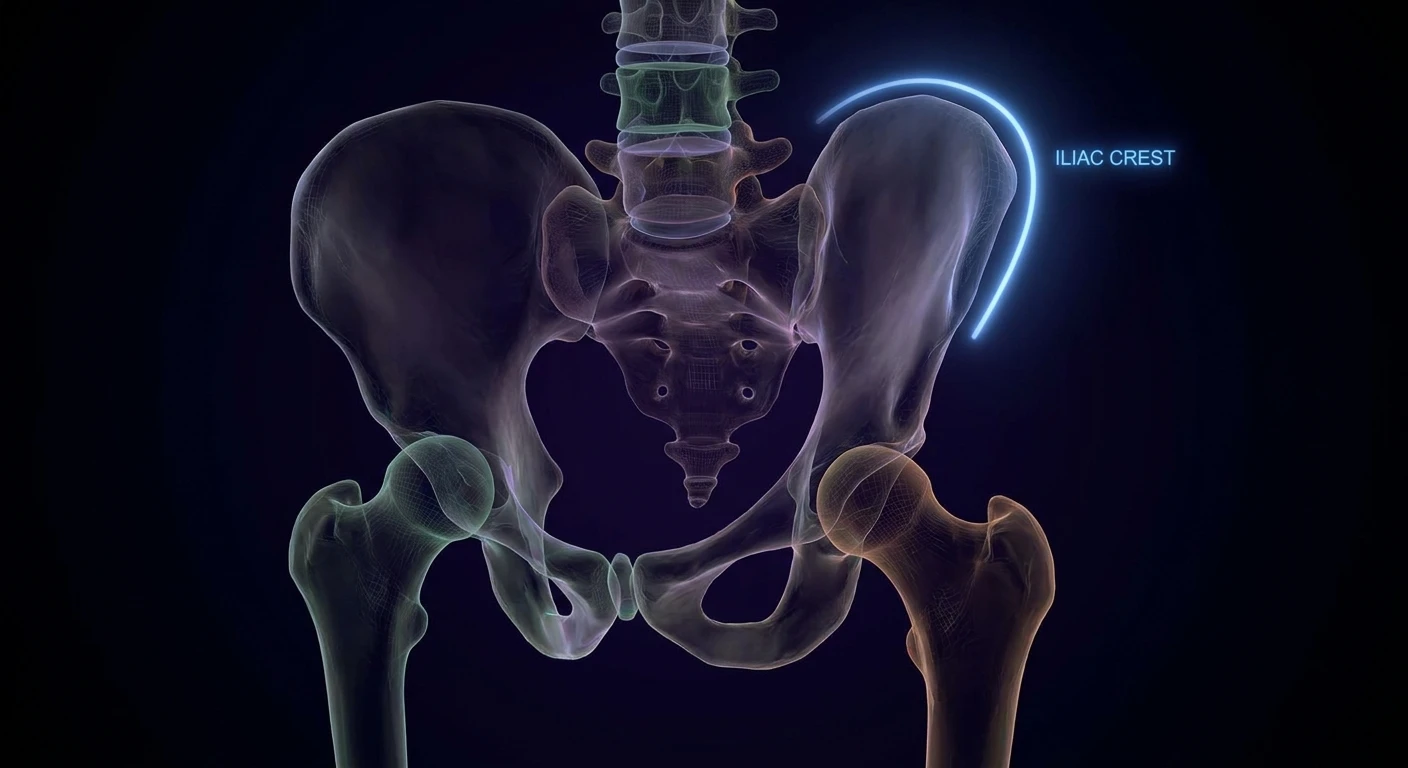
All About Your Iliac Crest: Why That Hip Bone Matters
Have you ever reached down to your waist and felt that prominent, curved bone just above your hip? That is your iliac crest. I remember trekking up Hoverla, Ukraine’s highest peak, a couple of years back. My massive 60-liter backpack was strapped tightly, sitting directly on my waistline to distribute the weight. By day two of the hike, the continuous, grinding friction against my hip bones was absolutely brutal. That was my painful, highly memorable, and highly real-world introduction to this specific part of the human pelvis.
The iliac crest is essentially the uppermost and largest bone of your pelvis. It acts as the ultimate anchor for several major core, back, and leg muscles. Whether you are a competitive athlete dealing with a frustrating sports injury or just someone trying to sit comfortably at your home office desk without aching, understanding how this vital pelvic ridge functions is incredibly critical for your daily mobility.
I am going to walk you through exactly what it does, why it hurts sometimes, and precisely how to keep it healthy. Since we are well into 2026, medical sports science gives us better, faster tools than ever to manage hip and lower back mechanics. We have better imaging, better recovery protocols, and better ergonomic understanding. So let’s get straight to the facts and figure out how to keep your hips moving smoothly without that nagging, sharp pain.
What Exactly Does It Do and Why Does It Cause Pain?
The iliac crest serves as the crucial, heavily trafficked crossroads between your lower body and your core. It is the primary attachment point for massive muscles like the latissimus dorsi in your back, the gluteus maximus in your rear, and the powerful oblique abdominal muscles that wrap around your sides. Think of it as the structural, weight-bearing foundation of a house. When the foundation is stressed, tilted, or damaged, the entire building feels the shockwaves.
Recognizing the earliest signs of distress right here provides a huge biomechanical advantage. For example, marathon runners who identify iliac apophysitis early can adjust their stride, swap out their footwear, and entirely avoid months of expensive, tedious physical therapy. Another example: heavy weightlifters recognizing micro-muscle pulls near the crest can immediately modify their squat depth and stance, preventing a minor tweak from becoming chronic, debilitating lower back strain.
Here is a quick breakdown of common issues:
| Condition | Primary Cause | Typical Symptom |
|---|---|---|
| Iliac Crest Contusion (Hip Pointer) | Direct blunt force impact | Sharp, localized bruising and severe tenderness |
| Apophysitis | Overuse, common in growing teens | Aching, throbbing pain during running or jumping |
| Iliotibial Band Syndrome | Friction and chronic tightness | Outer hip stiffness radiating down to the knee |
| Enthesopathy | Prolonged tendon tension | Chronic aching where the muscle meets the bone |
There are a few massive reasons this ridge is so medically significant:
- Structural Support and Balance: It literally holds up your belt and transfers the heavy weight of your upper spine evenly down into your legs.
- Prime Muscle Anchor: It provides a massive, curved surface area for thick muscle tendons to grip tightly, allowing you to twist, bend, and lift.
- Vital Bone Marrow Hub: Doctors frequently use this incredibly thick bone as a primary, safe site for harvesting bone marrow for critical medical procedures.
The highest point of the iliac crest rests roughly at the horizontal level of the L4 vertebra in your spine. This convenient alignment makes it a perfect, reliable anatomical landmark for doctors performing delicate spinal taps, epidurals, or nerve injections. If you trace the bone all the way forward toward your stomach, you hit a bony bump called the anterior superior iliac spine (ASIS). If you trace it backward toward your spine, you find the posterior superior iliac spine (PSIS). Both of these specific spots are prime real estate for dense muscle attachments and, unfortunately, frequent sites of annoying overuse injuries.
Origins of the Anatomical Name
Where did this specific medical name actually come from? The word “ilium” is directly derived from the ancient Latin word for flank or groin. Ancient Roman, Greek, and early Renaissance anatomists first documented this broad, fan-shaped bone when trying to accurately map out the complex human skeletal structure. They recognized it as the thick protective wall shielding the delicate lower digestive and reproductive organs. The term “crest” simply refers to a natural ridge, summit, or peak—perfectly describing the curved, rugged upper border of the ilium bone that sits near your skin’s surface.
Evolution of Pelvic Structure
From an evolutionary biology standpoint, the human iliac crest is a total marvel of natural engineering. When our distant ancestors slowly transitioned from walking on four limbs to full bipedalism (walking on two legs), the pelvis had to undergo radical, structural changes. The ilium bone became significantly shorter and much broader. This wide, flared shape allowed for a wider crest, giving our massive gluteal muscles the extreme mechanical leverage they desperately needed to keep our heavy upper bodies upright. Without this specific, dramatic evolutionary tweak, walking upright on two legs without constantly falling forward would be biomechanically impossible. The flared structure essentially balances the entire spine perfectly over the legs, acting as a natural counterbalance.
Modern State of Medical Understanding
Today in 2026, our clinical understanding of the iliac crest goes far beyond just basic bone anatomy. Advanced 3D biomechanical computer modeling shows us exactly how microscopic forces distribute across this bony ridge during highly complex movements like sprinting, changing direction, or heavy lifting. Orthopedic surgeons now regularly utilize robotic-assisted techniques to precisely navigate around the crest during complex hip replacements, minimizing muscle damage. Furthermore, because of its incredibly rich supply of cancellous (spongy) bone, it remains the absolute gold standard for bone grafting globally. If a skilled surgeon urgently needs viable bone to repair a shattered jaw or fuse a damaged spine, they often take a small piece from this very crest, knowing confidently that the pelvic bone will regenerate reliably.
Biomechanics and Muscle Attachments
To truly grasp the complex engineering of the pelvic girdle, you have to look closely at the extreme tension forces applied directly to the iliac crest every single day. It is entirely enveloped by thick, fibrous muscle fascia. The external oblique, internal oblique, and transversus abdominis all anchor heavily to the anterior (front) two-thirds of the crest. This means every single time you twist your torso to grab something, you are pulling directly on this bone. Meanwhile, the posterior (back) third acts as the origin for the quadratus lumborum, a very deep, powerful lower back muscle. When these muscles lack proper flexibility, they create a constant, exhausting tug-of-war on the bone surface. This prolonged, daily tension causes chronic microscopic inflammation at the attachment sites, clinically known as enthesopathy. Over time, this feels like a deep, dull ache that just will not go away.
Bone Composition and Grafting Science
Structurally, the crest is entirely unique compared to your arm or leg bones. It features a thick, hard cortical shell on the outside but is packed full of highly porous, trabecular (spongy) bone on the inside. This spongy interior is literally a biological factory for red blood cells and powerful stem cells.
- Hematopoietic Stem Cells: The marrow inside the crest is incredibly rich in raw stem cells that can develop into any type of blood cell your body needs.
- Osteogenic Potential: Tissue harvested from here contains living, highly active bone cells (osteoblasts) that rapidly jumpstart the healing process when surgically transplanted elsewhere in the body.
- Thick Cartilage Cap: In adolescents, the crest is covered by a soft cartilaginous apophysis that gradually ossifies (hardens into solid bone) by the time they reach age 20.
When a direct blow forcefully crushes the soft tissue against the hard cortical shell of the crest, it easily ruptures blood vessels, causing a hematoma. Because the skin right here is very thin and there is virtually no fat padding to protect it, blood pools quickly between the muscle and the bone. This creates extreme pressure and the notorious, sharp, agonizing pain of a “hip pointer” injury.
Day 1: Immediate Cryotherapy
Stop all strenuous physical activity immediately. Apply ice packs (wrapped securely in a thin towel) directly to the top of the hip for 15 minutes every two hours. Focus on strict rest today to drastically minimize the initial internal hematoma bleeding and surface swelling.
Day 2: Compression and Elevation
Wrap an elastic compression bandage snugly around your waist to help push excess swelling out of the local tissues. Sleep at night with a thick pillow underneath your knees to slightly elevate the legs and take the pulling tension off your hip flexors and lower back muscles.
Day 3: Gentle Active Range of Motion
Start doing very small, entirely pain-free movements. Try gentle pelvic tilts while lying flat on your back on a yoga mat. Avoid any deep, aggressive stretching or violent twisting of the torso, as the tissue is still highly fragile.
Day 4: Heat Therapy Integration
Switch your strategy from ice to a warm heating pad. The steady heat increases local blood flow, which rapidly flushes out dead cellular debris from the bruised area. Keep doing the gentle pelvic tilts to prevent stiffness.
Day 5: Isometric Core Activation
Begin engaging the core muscles attached to the crest without actually moving the spine or joints. Simple abdominal bracing—tightening your stomach exactly like you are about to be punched—helps wake up the transverse abdominis safely.
Day 6: Light Stretching
Introduce gentle, highly controlled stretches for the quadratus lumborum and side obliques. The standing side-bend is highly effective here, but only go until you feel a very mild pull. You should never feel sharp, stabbing pain while doing this.
Day 7: Functional Movement Testing
Try an easy, brisk 15-minute walk or lightly pedaling on a stationary gym bike. If you can perform these simple actions without limping, wincing, or changing your natural gait, you can slowly begin reintroducing your regular workouts next week at a much lower intensity.
Common Myths About Pelvic Health
Myth: A bruised hip bone is just a minor injury you can easily play through.
Reality: A direct contusion to the iliac crest (hip pointer) can cause debilitating pain, trigger severe muscle spasms, and require several weeks of strict rest to fully heal properly. Playing through it just causes more bleeding.
Myth: Only professional athletes get iliac crest pain.
Reality: Desk workers frequently develop chronic inflammation here because prolonged sitting drastically shortens and tightens the hip flexors, which tug relentlessly on the pelvic bone all day long.
Myth: You should aggressively stretch a hurting hip to fix it.
Reality: Aggressive, deep stretching can actually tear the fragile, newly healing micro-fibers at the tendon-bone junction. Gentle, progressive mobility is far safer and much more effective.
Myth: Lower back pain has absolutely nothing to do with the front of your hips.
Reality: The quadratus lumborum muscle connects your lower spine directly to the posterior iliac crest; mechanical tension right here is a leading, often-ignored cause of severe backache.
What is the exact location of the iliac crest?
It is the curved, uppermost edge of your ilium, which is the largest bone in your pelvis. You can easily feel it by naturally resting your hands on your hips.
Can I fracture my iliac crest?
Yes, severe blunt trauma from car accidents or extreme contact sports can cause avulsion or compression fractures, though they are relatively rare compared to soft tissue injuries.
Why do I have a weird lump on my iliac crest?
A distinct lump could be a localized hematoma (blood pool), a benign lipoma (fatty cyst), or severe tendon inflammation. Always get any new, unexplained lumps checked out by a medical professional.
How long does a classic hip pointer take to heal?
Mild, surface-level cases generally take 1 to 3 weeks, while severe contusions with deep muscle involvement might take up to 6 weeks to fully resolve.
Does sciatica directly involve the iliac crest?
Not directly, but extremely tight muscles anchoring around the crest can physically compress nearby nerves, mimicking the exact burning pain of sciatica.
Can sleeping heavily on my side cause crest pain?
Yes, sleeping on a mattress that is way too firm can easily create painful, concentrated pressure points directly on the bone surface.
Are medical injections given in the iliac crest?
Sometimes. Doctors frequently use this highly accessible area for bone marrow biopsies or specific local anesthetic nerve blocks.
Is walking good for hip bone pain?
Light, controlled walking promotes vital blood flow and prevents crippling stiffness, but you should completely stop if it causes sharp, stabbing pain.
Do belts cause iliac crest nerve compression?
Yes, wearing a heavy, tight belt can compress the lateral femoral cutaneous nerve as it passes near the crest, causing numbness in the thigh.
Your pelvic health ultimately dictates your overall daily mobility. Treat it right, respect the biomechanics, and do not ignore the pain signals. Drop a comment below if this detailed guide helped you, and be sure to share it with a friend who always complains about their stubborn hip pain!





Leave a Reply