

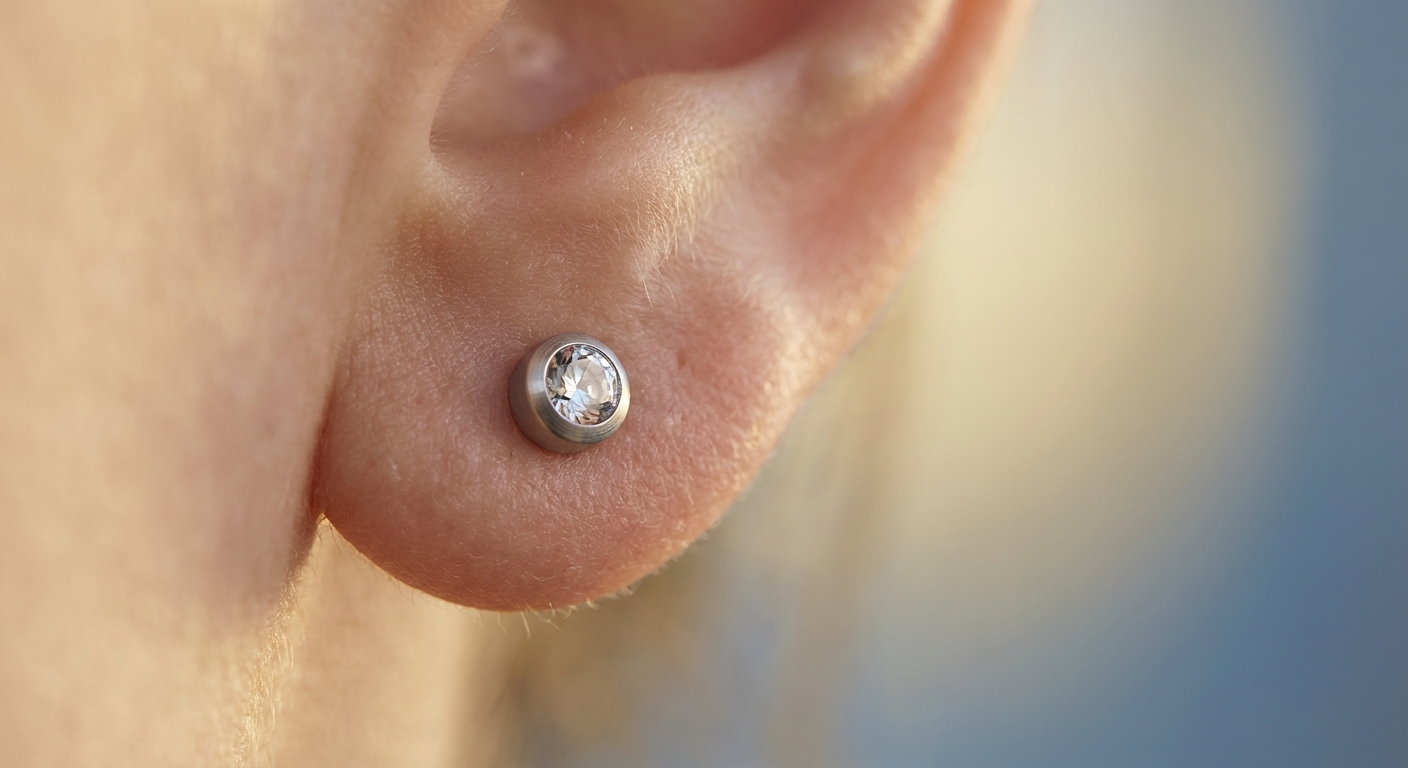
Is It a Piercing Bump vs Keloid? Let’s Figure It Out
Trying to figure out if you have a piercing bump vs keloid can seriously freak you out. When you look in the mirror and see an angry, red lump growing right next to your brand-new jewelry, panic is usually the first reaction. Knowing exactly what is growing next to your piercing is the only way to treat it right and save your skin without making things worse.
I was hanging out at my friend’s tattoo and piercing shop down in Podil, Kyiv just last week. The shop smelled like fresh green soap and coffee. A client rushed in, nearly crying, absolutely convinced she had a massive keloid developing on her new daith piercing. She had been googling pictures all night and was terrified she would need surgery. My friend took one look, smiled, and calmly explained it was just a standard irritation bump caused by her sleeping on it. It got me thinking about how many people suffer through this exact same anxiety attack. We hit the year 2026, and despite having endless information at our fingertips on our phones, people still confuse these two conditions daily. You sit there doom-scrolling, looking at worst-case scenarios, when you probably just snagged your ear on a sweater. I am going to break down exactly what you are looking at so you can chill out, stop stressing, and take the correct steps to fix your skin.
The Core Differences That Save Your Skin
Let me level with you about why identifying the issue correctly matters so much. If you treat a true keloid like a standard irritation bump, it continues to grow unchecked. If you treat a simple bump like a keloid, you waste money on unnecessary medical treatments and stress yourself out for absolutely no reason. Understanding the real difference gives you total control over your healing process and saves your wallet.
Think about the value of knowing your body. For instance, if you apply warm sterile saline to a regular bump, it starts shrinking within days. You save your piercing and go about your life. If you try that on a true keloid, absolutely nothing happens. Or think about all those harsh DIY remedies people recommend online—great for absolutely nothing, and potentially disastrous for dense scar tissue. Knowing the difference empowers you to make smart, safe choices.
Here is how you actually diagnose the situation at home before calling a doctor:
- Check the timeline. Irritation bumps show up pretty quickly after a snag, a jewelry change, or accidentally sleeping on the piercing. Keloids are incredibly slow. They take months to slowly build up their dense tissue.
- Analyze the growth boundaries. Does the lump stop growing once it reaches a certain manageable size around the jewelry? That is an irritation bump. Does it continuously grow past the original wound site, completely swallowing the area? That points strongly to a keloid.
- Feel the texture (gently). Bumps feel like pimples or fluid-filled blisters. They are soft and sometimes scabby. Keloids feel like hard rubber or dense plastic buried right under your skin.
| Feature | Irritation Bump | Keloid Scar |
|---|---|---|
| Color | Red, pink, or completely skin-toned | Dark pink, dark red, or purple |
| Growth Behavior | Stays localized around the piercing site | Grows aggressively beyond the initial wound |
| Texture | Soft, fluid-filled, crusty, or scabby | Hard, rubbery, dense fibrotic tissue |
| Pain Level | Tender, stinging, or throbbing | Often painless, but can be deeply itchy |
When your skin reacts to foreign metal or physical trauma, it is just trying to protect you. The specific way it decides to protect you tells you everything you need to know about your next move.
Origins of Piercing Complications
Humans have been piercing their bodies for thousands of years. Mummies from ancient Egypt and Ötzi the Iceman showed clear signs of stretched earlobes and body modifications. Back then, they did not have sterile environments, autoclaves, or implant-grade titanium. They used sharpened bones, thorns, and heavy stones. Naturally, their bodies reacted violently to these materials. The historical records suggest that early civilizations dealt with massive scar tissue formations, though they viewed them as tribal markings and rites of passage rather than medical annoyances. True keloids actually have a strong genetic component, heavily documented in specific populations close to the equator, where intentional scarification was a respected cultural practice. The body’s biological response was harnessed for art.
The Evolution of Piercing Care
Fast forward to the 1990s and early 2000s mall culture, and things got messy. Piercing guns became the absolute standard for everyone getting their first lobes done. These brutal, spring-loaded devices forced blunt jewelry straight through the tissue, causing massive blunt force trauma. The result? A global epidemic of nasty irritation bumps. People instantly assumed these were keloids because the trauma was so severe the swelling looked monstrous. We spent decades fighting terrible advice, using harsh chemicals like rubbing alcohol, hydrogen peroxide, and antibacterial ointments, which ironically trapped the bacteria and made the bumps bigger and angrier. The terminology got entirely mixed up in the public consciousness.
Modern State of Body Modification
Now, the industry is vastly superior. Professional piercers use razor-sharp, single-use hollow needles that cleanly slice rather than crush the delicate tissue. The modern standard is all about minimizing trauma and encouraging natural healing. However, the old myths somehow survived. We now have an incredibly clear understanding of dermatology. We know for a fact that a bump is a temporary inflammatory response, while a keloid is a permanent misfire in the collagen-production system. Still, the visual similarities keep clients guessing every single day.
The Biology of an Irritation Bump
Let me explain what your body is actually doing beneath the surface. An irritation bump is basically a pocket of trapped fluid, dead skin cells, and white blood cells rushing to defend an area that feels threatened. Dermatologists call this a granuloma or a pustule. When you sleep heavily on your cartilage piercing, the mechanical pressure creates microscopic tears in the healing fistula (the delicate tube of skin forming around the metal jewelry). Your immune system detects the damage and sends a massive rush of blood and healing factors to fix the micro-tear, resulting in a swollen, red pocket of fluid. It is purely a localized inflammatory response. Once you completely remove the trigger—like swapping out cheap nickel jewelry for smooth implant-grade titanium—the body simply absorbs the fluid, flushes the waste, and the bump vanishes completely without a trace.
The Science Behind True Keloid Scarring
A keloid is an entirely different beast at the cellular level. This is not just trapped fluid; it is a fundamental glitch in your skin’s healing code. When your skin gets pierced, specific cells called fibroblasts rush into the wound to lay down collagen and rebuild the broken tissue. In a normal person, the fibroblasts receive a chemical signal to stop working once the hole is secure. In someone genetically prone to keloids, the fibroblasts never receive that “stop” signal. They just keep building, stacking thick scar tissue endlessly.
- Overproduction of Collagen: Fibroblasts in keloid-prone individuals produce type I and type III collagen at a rate up to 20 times higher than normal healing tissue, creating the dense mass.
- Genetic Predisposition: True keloids are heavily linked to family genetics, specifically tied to the HLA-B14 and HLA-BW16 antigens. If your immediate family members do not get them, your chances of developing one from a piercing are incredibly low.
- Lack of Regression: Unlike hypertrophic scars or simple fluid bumps, true keloid tissue does not shrink on its own over time. It requires aggressive medical intervention like corticosteroid injections, laser therapy, or cryotherapy to break down the dense collagen bands.
- Vascularization: The dark purple or deep red color of a keloid comes from highly concentrated, newly formed blood vessels that continuously feed the endless scar tissue growth.
Your 7-Day Action Plan
If you are staring at an angry lump right now, here is exactly what you are going to do for the next week. This strict 7-day protocol is designed to tackle inflammation safely and effectively. Do not skip any steps.
Day 1: The Hands-Off Assessment
Stop touching it immediately. Take a clear, well-lit, close-up photo of the bump today. You need a baseline visual to track if it is actually growing or shrinking. Do not squeeze it, scratch it, or pick the crust off, no matter how much it looks like a juicy pimple.
Day 2: The Jewelry Check
Evaluate the metal sitting in your ear or nose. Are you wearing cheap surgical steel? That metal alloy contains nickel, which causes massive allergies. Go to a reputable piercer today and swap it for an implant-grade titanium flat-back labret. The irritation might literally stop right there once the allergen is gone.
Day 3: Warm Saline Compresses
Start doing sterile saline compresses twice a day. Buy canned sterile saline wound wash (0.9% sodium chloride). Spray it generously onto a clean non-woven gauze pad, microwave the pad for about three to five seconds until comfortably warm, and hold it gently against the bump for five solid minutes. The warmth draws out the trapped fluid.
Day 4: Evaluate Your Sleep Habits
Are you sleeping on that side of your head? Mechanical pressure is the number one cause of bumps. Buy a travel neck pillow immediately. Sleep with your ear suspended in the center hole so absolutely zero pressure is applied to the healing piercing while you rest at night.
Day 5: Dry It Out Safely
Moisture breeds massive bumps. Leaving your piercing wet after a shower is a huge mistake. After your shower or saline wash, use the cool setting on a clean hair dryer to gently blow dry the piercing from a distance. Make sure the area is bone dry.
Day 6: Compare the Progress
Take another photo under the exact same lighting. Compare it to your Day 1 picture. Is the redness fading? Is the lump slightly smaller or flakier? If yes, congratulations, it is definitely a standard irritation bump. Keep up the saline routine and be patient.
Day 7: The Dermatologist Decision
If a full week of perfect care, titanium jewelry, zero sleeping pressure, and saline compresses results in the bump getting noticeably harder, larger, and extending weirdly beyond the piercing hole, it is time to stop home treatments. Call a board-certified dermatologist. You might be dealing with a genetic keloid that needs professional medical treatment like steroid shots.
Separating the Myths from the Reality
There is so much dangerous garbage advice floating around social media right now. Let’s clear up the nonsense so you do not permanently scar your face or ears.
Myth: Crushing aspirin into a thick paste cures keloids quickly.
Reality: Aspirin paste is just a harsh, unmeasured acid that chemically burns the delicate top layer of your skin. It might aggressively burn off a tiny irritation bump, but it will do absolutely nothing to the deep, dense scar tissue of a real keloid except make it severely irritated and prone to infection.
Myth: Pure tea tree oil is the ultimate piercing bump killer.
Reality: Essential oils are incredibly caustic to raw, healing fistulas. Using tea tree oil almost always causes severe contact dermatitis, making the swelling aggressively worse. Stick exclusively to sterile saline.
Myth: If you get a bump, you must take the jewelry out immediately to let it heal.
Reality: Taking the jewelry out of an infected or highly irritated bump can trap the bacteria inside as the surface hole closes up quickly, leading to painful trapped abscesses. Always leave the jewelry in to allow proper drainage while you treat the root cause.
Frequently Asked Questions
Can an irritation bump turn into a keloid?
No, they are biologically completely different things. A fluid-filled bump cannot magically transform into genetic scar tissue. You either have the genetic predisposition for keloids or you do not.
Does changing the jewelry shrink the bump?
Yes, absolutely. If the bump is caused by a metal allergy or poor jewelry shape (like a tight hoop), swapping to a straight titanium bar fixes the irritation fast.
How fast do true keloids grow?
Very slowly. They typically take months to visibly form and continue growing steadily over years if left untreated by a doctor.
Do irritation bumps bleed?
Sometimes, especially if you accidentally snag them on a shirt collar or brush them too hard while washing your hair. They are full of fluid and blood.
Can I pop a piercing bump with a needle?
Absolutely not. Popping it causes massive tissue trauma, introduces dangerous bacteria from your fingers, and guarantees the bump will come back twice as large.
Do keloids hurt?
They can be highly itchy or tender to the touch, but they usually do not have the sharp, stinging pain of an inflamed or infected fluid bump.
Should I use hydrogen peroxide to clean the area?
Never. Peroxide destroys healthy, regenerating skin cells alongside the bad bacteria, severely delaying your recovery and making the bump worse.
How often should I use the saline spray?
Twice a day is the golden rule. Over-cleaning the piercing dries out the skin too much, which ironically creates more irritation and delays the healing process.
Figuring out your skin issues does not have to be a nightmare of anxiety and stress. By keeping your hands completely off, using only sterile saline, avoiding terrible internet remedies, and closely watching the growth patterns, you can easily tell the difference between these two issues. Stick to the 7-day plan, trust the process, and listen to your body. If you are still stressed out about your ear, drop a comment below or share this guide directly with your piercing buddy who is currently panicking in front of their mirror!



Leave a Reply